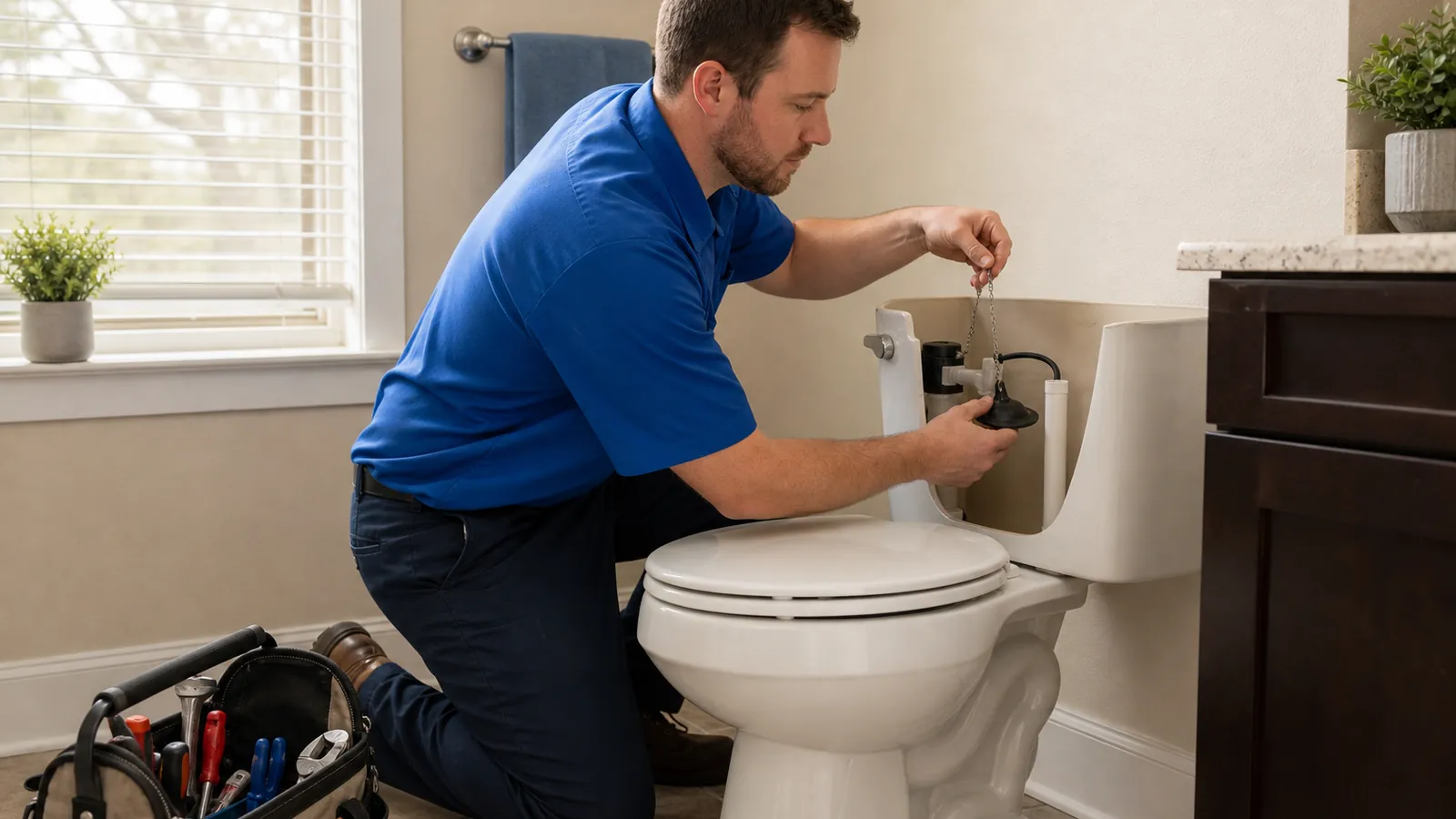
A sewer smell in a Ruston home means gas from the drain system has found a way past a seal that should block it. The usual suspects are a dry trap, a failed toilet wax ring, a loose cleanout cap and a blocked vent, and several of them take only minutes to check. Here is how each one fails, how to narrow down the source, and when the odor calls for a plumber.
How Sewer Gas Gets Past Your Plumbing
Every drain in the house feeds one main line to the city sewer or a septic tank, and that line holds gas from decaying waste. The Wisconsin Department of Health Services notes that sewer gas can include hydrogen sulfide, ammonia and methane.
Two defenses keep that gas outside. The first is the trap, the curved pipe under each sink, tub, shower and floor drain, which holds a small plug of water that stops gas from rising into the room. Toilets have the same seal built into the porcelain.
The second defense is the vent system. Vent pipes run up through the roof, where the vent stack lets gas out and air in. Without that air, water rushing down a drain can pull a vacuum and siphon nearby traps dry.
A sewer smell shows up when one of these defenses fails, or when a pipe, seal or cap between them starts to leak.
Common Sources of a Sewer Smell in the House
Each source leaves its own pattern, so where and when you notice the odor matters.
- Dry P-trap: a guest bath, a rarely used shower or a garage floor drain can sit for weeks while its water seal evaporates. Long, hot North Louisiana summers can speed that loss in a closed-off room.
- Failed wax ring: a toilet seals to the flange in the floor with a wax ring. If the toilet rocks or was reset poorly, the ring can shift, and odor seeps out at the base.
- Loose or missing cleanout cap: cleanouts are capped access fittings on the drain line. A cracked or missing cap is an open door for gas.
- Blocked vent stack: leaves or a bird nest can plug the vent at the roof. Drains then gurgle and can siphon a trap dry.
- Cracked drain pipe: a crack under a slab or inside a wall can leak gas without any visible water.
- Dry washer standpipe: the washing machine drain has its own trap, and it can dry out when the machine sits unused.
A Ruston Scenario You Might Recognize
Picture a family whose hall bathroom smells like a sewer every few days, mostly in the late afternoon, while the second bathroom smells fine. After someone showers in the hall bath, the odor fades, then creeps back. Nobody sees a leak, and the toilet feels solid.
To a plumber, that pattern points away from the toilet and toward the tub or sink trap. Here, the odor tracks with how recently the tub was used, which suggests a seal that is lost between uses. If the bathroom drains also gurgle when the toilet flushes, a partly blocked vent may be siphoning the trap. If they drain quietly, slow evaporation in a warm room is the likelier cause.
What You Can Check Safely at Home
You can narrow down a sewer smell without any tools. Open a window first if the odor is noticeable.
- Map the odor: walk room to room and note where the sewer smell is strongest. Check floor drains, the washer box, sink cabinets and each toilet base.
- Refill unused fixtures: run water for a minute in every rarely used sink, tub, shower and floor drain. North Dakota State University Extension suggests a quart of water in idle drains every three to four weeks.
- Check each toilet: try to rock the bowl gently and look for movement or stained flooring. A loose toilet calls for toilet repair and a new wax ring.
- Listen for gurgling: flush a toilet or drain a full tub, then listen at nearby drains. Gurgling suggests air is being pulled through a trap instead of the vent.
- Look at cleanouts: confirm any caps you can reach safely are in place and intact.
Leave the roof to a plumber, who can clear a blocked vent as part of professional drain cleaning.
How a Plumber Confirms the Source
When the easy checks do not solve it, a plumber has several ways to locate a hidden leak.
- Smoke test: harmless, visible smoke is pushed into the drain system through a cleanout or the roof vent. The smoke escapes wherever gas could, such as a cracked fitting inside a wall cavity.
- Peppermint test: strong peppermint oil and hot water go down the vent at the roof. If someone inside smells mint, the drain or vent piping has a leak nearby.
- Camera inspection: a waterproof camera on a cable travels through the drain line to find cracks, separated joints or roots. A video sewer inspection is often the clearest way to check a line under a slab without breaking the floor.
A smoke test can show that a leak exists, and a camera can then show which section of pipe has failed.
Safety Notes
- Strong odor or symptoms: sewer gas can contain hydrogen sulfide, which smells like rotten eggs. If the smell is strong, or anyone gets a headache or nausea, open the windows and leave the house. For any health concern, follow the advice of a doctor or poison control.
- Possible natural gas: utilities add an odorant to natural gas that also smells like rotten eggs. If the smell is near a gas water heater, furnace, range or dryer, leave the house right away. Call your gas utility's emergency line or 911 from outside, and do not flip light switches on the way out.
- A fading smell is not proof: the CDC's Agency for Toxic Substances and Disease Registry notes that people can lose the ability to smell hydrogen sulfide at higher levels.
- Flammable gases: methane and hydrogen sulfide can both burn, so keep open flames away from a strong sewer odor.
- Chemicals: do not pour bleach or drain cleaner into a smelly drain. Mixing products can release toxic fumes.
When to Call a Professional
Call a plumber if refilling the traps does not clear the odor within a day or two, or if it keeps coming back. Call as well when a toilet rocks or smells at the base, since the fix means pulling the toilet, checking the flange and setting a new wax ring.
Gurgling drains, slow drains at several fixtures, or an odor inside a wall with no fixture nearby all point beyond a dry trap. Those signs can indicate a blocked vent, a main line clog or a cracked pipe. Mark Johnson & Sons Plumbing can run a camera through the line before anyone talks about breaking concrete. For a floor drain that dries out over and over, ask about a trap primer, a device that refills the trap automatically.
Frequently Asked Questions
Why does the sewer smell come and go?
It usually tracks with drain use. A drying trap may smell only between uses, and a partly blocked vent may siphon a trap only when a tub or washer empties a large volume of water at once.
Is a mild sewer smell dangerous?
A faint odor from a dry trap is often more nuisance than emergency, but it still means gas is entering the house. Health agencies connect sewer gas exposure to symptoms such as headaches and nausea, so the source is worth fixing promptly. Questions about symptoms belong with a doctor.
Can a bad wax ring smell without leaking water?
Yes. A wax ring can lose enough of its seal to let gas out with no water on the floor. The odor is usually strongest right at the toilet base.
Should I pour drain cleaner into a smelly drain?
No. Drain cleaner does not restore a trap seal, and harsh chemicals can be hard on older pipes. If the drain is also slow, mechanical cleaning clears the clog without adding fumes.
Your Next Step for a Sewer Smell in Ruston
Before you reach out, note which room the sewer smell is strongest in, whether it comes and goes, and whether any drains gurgle or run slow. Also list any fixtures that rarely get used, since those notes help a plumber decide where to start. If you already refilled the traps, mention how long the odor took to return.
Mark Johnson & Sons Plumbing helps Ruston homeowners reset leaking toilets, clear slow drains and inspect drain lines with a camera. Send your notes through our contact page or pick a time with online booking. If you smell rotten eggs near a gas appliance, leave the house first and call the gas utility from outside.