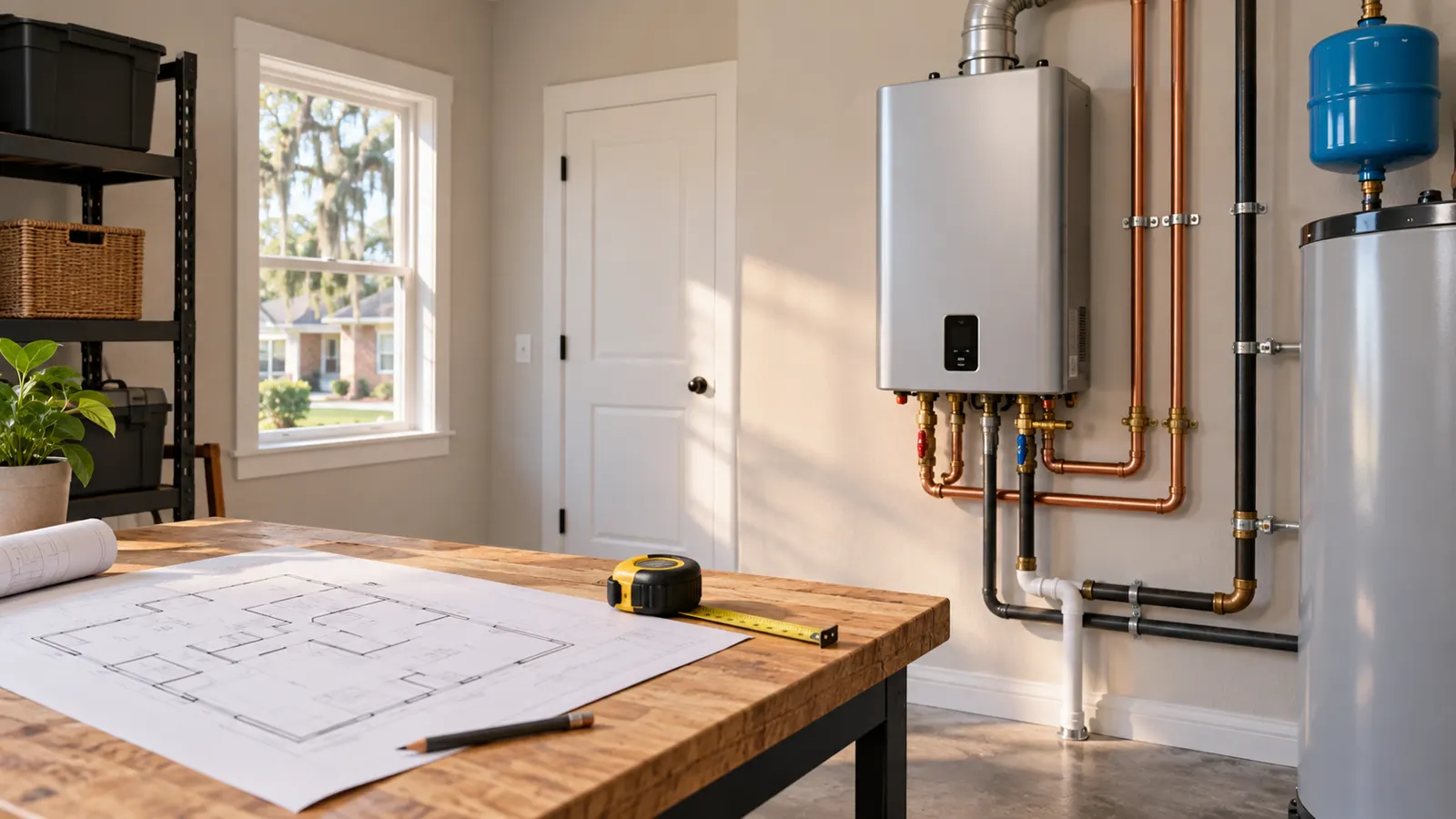
Planning a tankless water heater in Monroe, LA is a property assessment before it is an equipment decision. The house decides most of it, and the house has to be looked at.
This article walks through the factors a plumber evaluates on site: household hot water demand, gas and electrical supply, venting, where the unit can go, condensate drainage, service access, and long-term maintenance. It does not select a model, a size, or an operating outcome for your home, because none of that can be settled remotely.
Start with how your household uses hot water
A tankless unit heats water as it passes through, so the question is not your total use across a day. The question is the volume you draw at one moment.
Think about the peak. A shower running while the dishwasher fills is a different draw than one bathroom sink. Two showers at once, on different levels of the house, is different again.
Write down your real pattern before anyone visits. Number of bathrooms, how many people are home on a weekday morning, whether laundry overlaps with showers, and whether you have a soaking tub or a multi-head shower all belong on that list.
Incoming water temperature matters here
How hard the unit has to work depends on how cold the water is when it arrives and how hot you want it at the tap. The gap between those two numbers is the whole job.
In North Louisiana that gap moves with the season. Winter supply water is colder than summer supply water, which is why a unit that feels fine in August can feel different in January.
A plumber measures this at the property rather than assuming it. It is one of the clearest examples of why tankless planning cannot be done over the phone.
Confirm the gas and electrical supply
This is where most Monroe tankless projects either open up or narrow down, and it is a qualified trade question in every case. The water heater service page is the right place to start a property-specific conversation.
A gas tankless unit generally asks more of the gas supply than a storage tank does. The existing line size, the meter, and everything else already drawing gas in the house all have to be evaluated together. Whether that supply is adequate, or what would have to change, is determined on site.
Electric tankless units move the question to the electrical panel and the circuits that serve it. Available panel space and service capacity have to be confirmed by the appropriate trade before anything is planned around them.
Do not work out any of this yourself. Gas piping and electrical service are not homeowner territory, and the assessment is part of what a professional visit is for.
Venting drives the location
Gas tankless equipment has to vent combustion products safely outside, and the venting requirement is set by the manufacturer for the specific unit.
What a plumber is looking at is the path. How far the unit sits from an exterior wall or roof, what the vent would have to pass through, and what is in the way all shape what is workable.
There are also clearances to respect around windows, doors, soffits, and anything that draws air into the home. Those are manufacturer and code items, not preferences, and they frequently decide where the unit ends up.
Where the unit can actually live
Tankless units are compact, which leads people to assume placement is easy. Placement is usually the most constrained part of the project.
The location has to work for venting, for gas or electrical supply, for water connections, and for drainage all at once. A garage wall, an interior utility space, an attic, and an exterior wall each come with a different set of tradeoffs.
Distance to the fixtures you care about is part of it too. A unit placed far from the primary bathroom behaves differently at the tap than one placed close to it, and that is worth discussing before the location is fixed.
Condensate drainage is part of the plan
Condensing tankless units produce water as a byproduct of combustion, and that condensate is acidic. It needs a proper drain path, not an afterthought.
The plumber is looking for a suitable drain within reach, the slope to get there, and whether neutralization is called for by the manufacturer or local code. In an attic or over finished space, the consequences of getting this wrong are the reason it gets planned up front.
If no drain is nearby, that becomes part of the scope of work. It is better to find that during planning than on installation day.
Leave room to service the unit
A tankless water heater is serviceable equipment, and it will be serviced. Plan the space for that now.
Service access means clear working room in front of the unit, room to reach the connections, and a path to get to it that does not involve moving stored belongings every time. Isolation valves on the water connections are a common part of the installation for exactly this reason.
Also think about who has to reach it. An attic location that is awkward at installation stays awkward for every visit after that.
Plan for maintenance from the start
Tankless equipment expects periodic maintenance, and manufacturers publish what that looks like for their units, including any interval tied to the warranty.
Descaling or flushing on a manufacturer-defined schedule is typical, and the water at your property influences how that schedule plays out. Filters or screens on some units get attention on the same visit.
Ask during planning what maintenance the specific unit expects and how the installation makes that easier. Ask how the warranty terms treat it. Those answers belong in the plan, not in year three.
What the property visit confirms
Everything above comes together in one visit, and each item either opens a path or closes one.
- Your peak simultaneous hot water use across the household
- Measured incoming water temperature and the target at the tap
- Gas supply adequacy, or the electrical service where that applies
- A workable venting path with proper clearances
- A location that satisfies venting, supply, water, and drainage together
- A condensate drain path where the equipment needs one
- Service access and the working room around the unit
- The maintenance the chosen equipment will expect
Only after those are confirmed does equipment selection become a real conversation. That sequence is what keeps a tankless project from stalling partway through.
Useful background while you plan
If you want general homeowner reading on water heating before your visit, the U.S. Department of Energy publishes consumer information about water heating. Treat it as background on how the equipment categories work, not as a recommendation for your address.
Your own notes are more useful than any general article. Bring the household pattern you wrote down, along with anything you already know about your utility connections and the space you have in mind.
Next step for your Monroe project
A tankless water heater in Monroe is a good fit for some homes and an awkward fit for others, and the difference is found at the property rather than in a catalog. Mark Johnson & Sons Plumbing serves Monroe and North Louisiana, and water heater service is one of the areas the team covers.
Bring your demand notes and your questions to the visit. You can contact Mark Johnson & Sons Plumbing to schedule a property-specific assessment for your Monroe home.