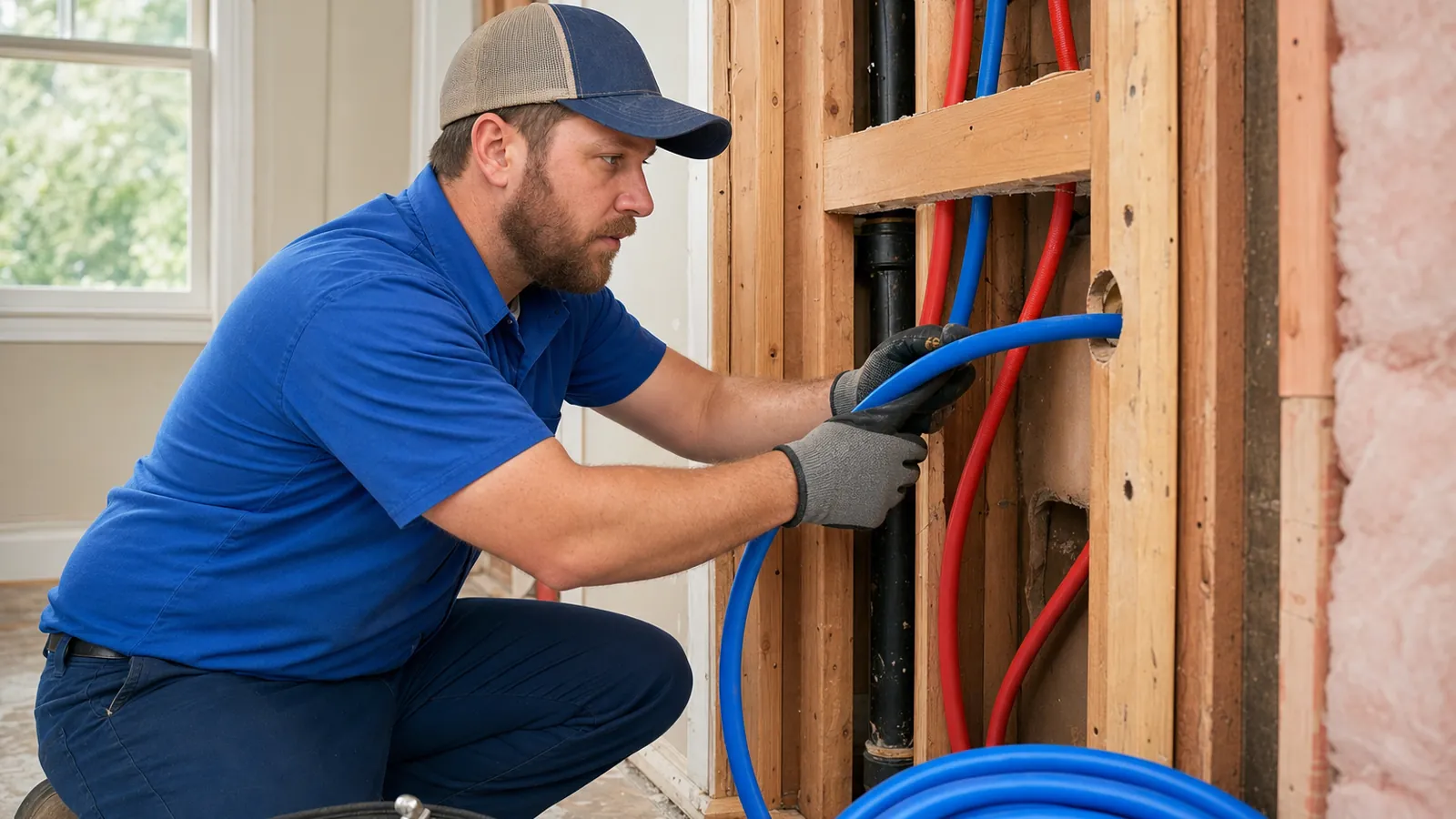
That loud bang in the wall when the washing machine stops filling has a name: water hammer. It can happen in any Bossier City home with pressurized supply pipes. Each bang is a pressure spike racing through your plumbing. Here is what causes it, how to tell it from other pipe noises, what you can check safely, and which fixes work.
How Water Hammer Actually Happens
Water flowing through a supply pipe is a heavy, moving column with real momentum. When a valve slows it gradually, that momentum fades quietly. When a valve snaps shut in a fraction of a second, the whole column stops almost at once.
That energy has to go somewhere. It becomes a sudden pressure spike at the closed valve, which engineers call hydraulic shock. The spike travels back up the pipe as a pressure wave and bounces between fittings until friction absorbs it.
You hear a sharp bang, sometimes followed by a few softer knocks as the wave fades. The pipe can also jump at elbows, and if it is not held firmly, it slaps against studs or joists.
Faster water makes a bigger spike. That is why the International Plumbing Code says flow velocity should be controlled to reduce the chance of shock.
What Triggers the Bang in a Typical Home
Most bangs start with a valve that closes faster than a hand could close it. A few conditions make the shock worse:
- Appliance solenoid valves: washing machines, dishwashers and refrigerator ice makers use electric valves that snap shut when a fill cycle ends.
- Single-handle faucets: a lever can go from full flow to off with one quick flick.
- High static pressure: more pressure means faster flow, and faster flow means a harder stop when a valve closes.
- Loose pipe straps: pipes that are not secured can move with each surge and strike the framing.
- Waterlogged air chambers: many older homes have short capped pipes behind fixtures that once held a cushion of air. Over the years, that air can dissolve into the water.
A worn part inside a faucet can make its own noise, too. If a tap chatters while it runs, faucet repair may be part of the answer.
Water Hammer or Another Pipe Noise?
Not every sound in the walls is the same problem, and timing is the best clue.
- Water hammer: a single bang or thud right as a valve closes, sometimes with a few fading knocks after it.
- Thermal expansion ticking: slow ticks or creaks as hot water lines warm up or cool down and rub against straps or framing.
- Whistling: a steady high note while water flows, often from a partly closed valve, a worn washer or a failing pressure-reducing valve.
- Chattering: a rapid rattle during flow, often from a loose washer or worn part in a valve or faucet.
The difference matters because the fixes are different. A whistle while the shower runs points at a valve or regulator. A bang when a fixture shuts off points at water stopping too fast.
A Bossier City Scenario You Might Recognize
Picture a family whose laundry room wall thumps every time the washing machine finishes filling. The kitchen faucet does something similar when someone flips the lever off quickly, but the bathroom sinks stay quiet. The noise used to be faint, and over the past year it has grown louder.
That pattern points to quick-closing valves meeting fast-moving water. The washer's solenoid valve and the single-handle kitchen faucet stop flow abruptly, while the older two-handle sinks close slowly. A bang that grows over time can mean house pressure has crept up, perhaps from a worn pressure-reducing valve, or that old air chambers have filled with water. The thump inside the wall also hints that a pipe is moving against loose straps or framing.
What You Can Check Safely
A few simple observations narrow the cause before anyone opens a wall.
- Find the trigger: turn fixtures on and off one at a time and note which ones bang.
- Read your water pressure: thread a hose-style pressure gauge onto an outdoor hose bib while no water runs inside. The EPA's WaterSense service pressure guidance describes this same test and recommends 45 to 60 psi.
- Look at exposed pipes: check under sinks and behind the washer for pipes that hang loose.
- Try recharging old air chambers: shut off the main, open the highest and lowest faucets, and let the lines drain. Close them and turn the main back on slowly. This only helps homes that have air chambers, and the relief may fade.
The same EPA guidance notes that most U.S. plumbing codes require a pressure-reducing valve when supply pressure exceeds 80 psi.
How Plumbers Fix Water Hammer
A plumber usually starts with a static pressure reading and a listen at the fixture that bangs. The fix depends on what those show, and many homes need more than one step.
- Water hammer arrestors: these sealed devices trap a cushion of air behind a piston, so they absorb the spike without waterlogging like an open air chamber. The IPC calls for an arrestor where quick-closing valves are used, built to the ASSE 1010 standard. Makers such as Sioux Chief sell residential models, including hose-thread versions for washing machine valves.
- A pressure-reducing valve: IPC Section 604.8 calls for one when static pressure in a building exceeds 80 psi. An existing valve can be adjusted, or replaced if it has worn out.
- Better pipe support: adding or tightening straps keeps pipes from striking the framing.
In an older home where supply pipes are corroded or already leaking, repiping may be worth discussing.
Safety Notes
- Know your main shutoff: find it and make sure it turns before you drain lines or loosen any connection.
- Hot lines can scald: when draining the system, open hot faucets slowly and keep your hands clear of the spout.
- Leave the water heater alone: draining the house lines is a separate job. Do not open the heater's drain or relief valve for this.
- Unplug appliances first: disconnect power to a washer or dishwasher before you touch its hoses or valves.
- Water near electricity: if a leak reaches an outlet, light fixture or the electrical panel, stay out of the wet area. Leave the room and call 911 if you see sparks or smoke.
- Use the right straps: choose straps made for your pipe material, since a steel strap on copper can corrode where they touch.
When to Call a Professional
Call when the bang is getting louder, when your gauge reads above 80 psi, or when you already have a pressure-reducing valve and the reading is still high. Arrestors inside a wall mean cutting into supply lines, which is work for a plumber with the right tools and fittings.
Repeated water hammer matters even before anything leaks. Each spike stresses joints, valves, faucet cartridges and appliance supply hoses, and over time that stress can lead to slow leaks inside walls.
If you notice damp drywall, a musty smell or a water meter that moves with everything off, water leak detection can find the source. If a line has already let go, shut the main and read about burst pipe repair.
Frequently Asked Questions
Is water hammer dangerous?
The bang itself is not usually an emergency. The concern is repeated spikes, which can wear on joints and hoses over time.
Why did the banging start suddenly?
Common reasons include a new appliance with a fast valve, a failing pressure-reducing valve, or air chambers that have filled with water.
Can I install an arrestor myself?
Hose-thread arrestors for a washing machine screw on between the valve and the hose, following the maker's instructions. Arrestors inside walls involve cutting into supply lines, so most homeowners leave those to a plumber.
Does high water pressure cause the banging?
High pressure does not create the valve slam, but it makes each spike stronger. Bringing static pressure into a normal range can make the noise much quieter.
Stop the Banging in Your Bossier City Home
Water hammer can get worse when the cause is left alone, so it makes sense to act while it is only a noise. Start by noting which fixtures bang, whether it happens on the hot side, the cold side or both, and what your hose bib gauge reads. Also note whether you have a pressure-reducing valve near the main.
Those details help a plumber target the right fix on the first visit. Reach out to Mark Johnson & Sons Plumbing through our contact page, or book a time online. Mark Johnson & Sons Plumbing can check your pressure, find the valve behind the noise, and explain whether arrestors, a pressure-reducing valve or better pipe support makes sense for your home.