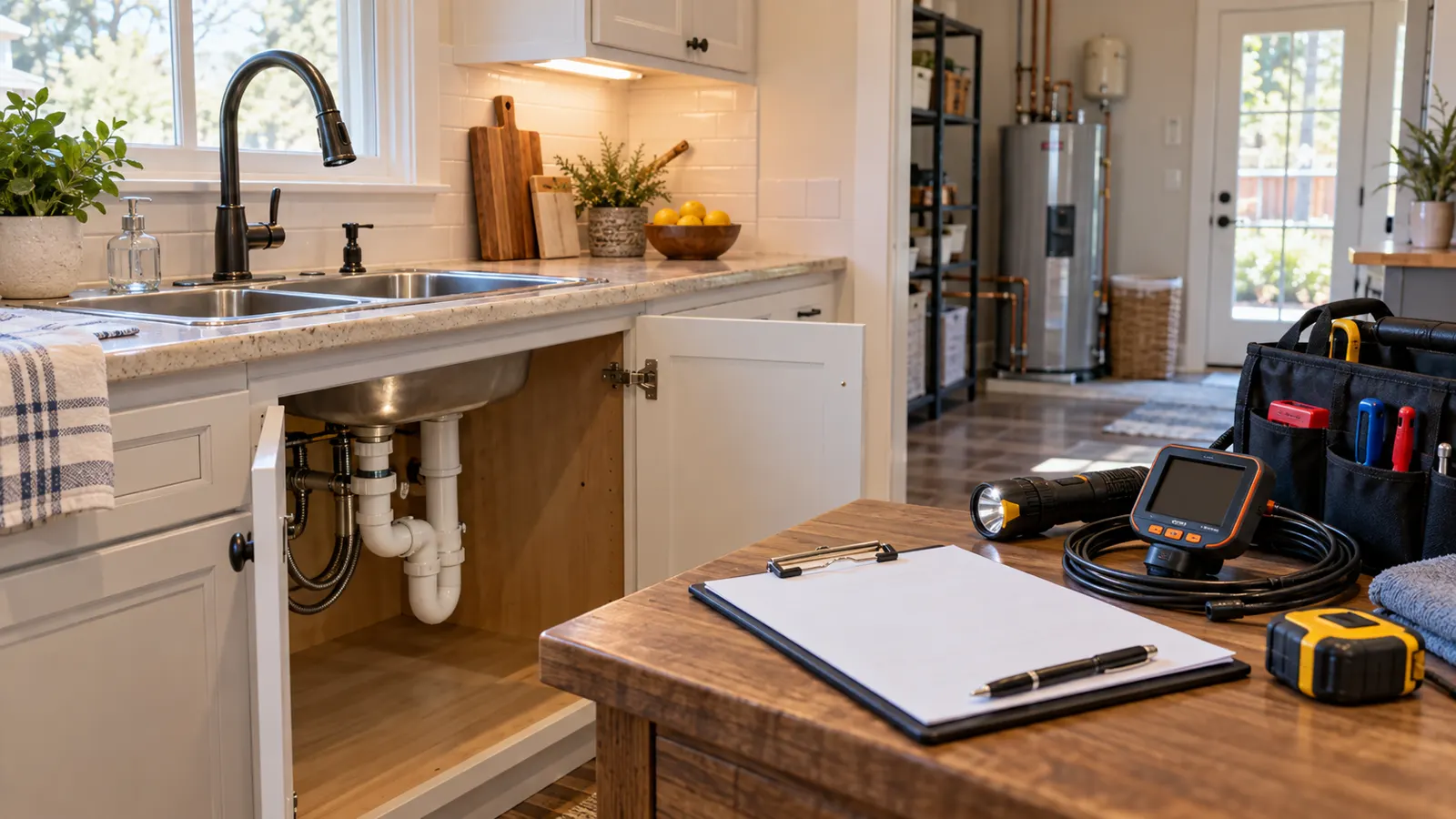
Booking a plumber is easy. Knowing what the appointment will actually look like is harder, and that uncertainty is why a lot of homeowners put off calling at all. Ruston plumbing visits follow a recognizable shape, and understanding that shape ahead of time makes the appointment easier to take part in.
This article describes the stages a service visit typically moves through: intake, observation, diagnosis, options, authorization, and documentation. It does not tell you how long any visit takes, what your particular problem is, or what the result will be. Those answers depend on the property and can only come from the person standing in front of the system. Mark Johnson & Sons Plumbing serves Ruston, LA, and the stages below describe how a professional visit is generally organized.
Stage one: intake, before anyone arrives
Intake is the conversation that happens when you book. It exists to match the visit to the situation, so the right work gets scheduled and the right information travels with the appointment.
Expect to be asked what you have noticed, which fixtures or areas are involved, when it started, and whether anything has changed since. You may also be asked practical questions about the property: where the water shutoff is, whether there is a crawl space or slab, and whether anyone has worked on the plumbing recently.
Intake is also where scope gets set. A visit booked to look at a situation is different from a visit booked to perform a specific repair. Ask which one you are booking, and ask what happens if the situation turns out to be different from how you described it over the phone.
The most useful thing you can bring to intake is observation rather than diagnosis. What you saw, heard, or smelled, and when. A homeowner's theory about which pipe is at fault can quietly steer the whole appointment in the wrong direction.
Stage two: observation on site
The visit opens with looking, not with tools. A plumber walking into an unfamiliar home is building a picture of the system before touching anything in it. If the concern centers on hot water, Mark Johnson & Sons Plumbing's water heater service page gives the relevant service context before the visit.
That usually means seeing the affected fixture or area, checking related fixtures that share supply or drainage, locating the shutoff, and looking at how the system is laid out. If the concern involves water where it should not be, the search often widens to where that water could be traveling from rather than where it is showing up.
You can make this stage go smoothly by clearing access in advance. Cabinets under sinks, the area around a water heater, closets, garage corners, and any utility space likely to be involved. Time spent moving boxes is time not spent on the actual problem.
This is also the point to mention things you left out when booking. A fixture that acted up last month and then stopped, a repair done by a previous owner, a recent appliance installation. Small history matters more than homeowners expect.
Stage three: diagnosis
Diagnosis is where observations become findings. It is a professional judgment, made on the property, using what can actually be seen and tested.
Some situations resolve quickly because the cause is visible. Others need the plumber to rule things out in sequence, because several different causes can produce the same symptom at the same fixture. A slow drain, a drop in hot water, or a damp spot on a floor can each trace back to more than one source.
Two things are reasonable to expect here. First, an explanation in plain language of what was found and how that conclusion was reached. Second, honesty about the limits of what could be determined during this visit. "We can see this much, and determining the rest requires opening or accessing that" is a legitimate finding, not a stall.
Questions worth asking during diagnosis
- What did you find, and what did you rule out?
- Which part of this is confirmed and which part is still an assessment?
- Is anything about this situation time sensitive?
- Does anything need to be accessed or opened before you can say more?
- Is the cause in one place, or does it involve more of the system?
Stage four: options
Once the findings are clear, the conversation turns to what can be done about them. A good options conversation lays out more than one path where more than one path genuinely exists, and explains what separates them.
Options are usually framed by scope rather than by outcome. Addressing the immediate symptom is a different scope from addressing the underlying condition, and a repair to one component is a different scope from work on the larger system it belongs to. Each carries different implications for what happens next.
Ask what each option covers, what it does not cover, and what is being left as it is. Ask what would prompt a different recommendation. If only one path is presented, ask why the alternatives were set aside, since the reasoning is often as useful as the recommendation.
Be cautious with any promise of a guaranteed result. Plumbing systems interact with soil, water quality, household use, and age, and a responsible recommendation accounts for what it cannot fully control.
Stage five: authorization
Authorization is the point where you decide. It belongs to you, and it should be a distinct, recognizable moment in the visit rather than something that happens by drift.
Work that goes beyond what was booked should be described to you and approved by you before it begins. That is the whole function of this stage. If the diagnosis expands the picture, you should hear about the change in scope, understand what it involves, and say yes or no.
It is fine to pause. Taking time to think, asking for the recommendation in writing, or deciding to handle part now and part later are all normal responses. A clear scope description you can read is worth more than a verbal summary you will half remember by evening.
If you decline part of a recommendation, ask what that leaves unaddressed and whether anything about the remaining condition needs watching. Declining is a valid choice, and you should make it with a clear picture of what it means.
Stage six: documentation
Documentation is what turns a visit into a record you can use later. It matters most months down the road, when you or a future plumber needs to know what was already looked at.
Useful documentation identifies the confirmed finding, the work authorized, and the next point of contact. Keep the full company-comparison checklist in the separate vetting draft so this article remains about what happens during the visit.
Ask before the visit ends how the summary will reach you and who to contact with a follow-up question. Keep it with your home records. Over several years, that file becomes the clearest history of the system that anyone has.
Getting ready for your visit
Preparation takes about ten minutes. Write down what you have noticed and when. Clear access to the areas likely to be involved. Know where your main shutoff is. Decide in advance that you want the findings and the recommended scope in writing.
None of that requires plumbing knowledge. It just changes your role in the appointment from bystander to participant, which is where better decisions come from.
Mark Johnson & Sons Plumbing works in Ruston, LA, with services covering emergency plumbing, water heaters, and water filtration. If your concern involves hot water specifically, you can see what the water heater service covers. To bring your notes to a conversation, reach Mark Johnson & Sons Plumbing and describe what you have observed.