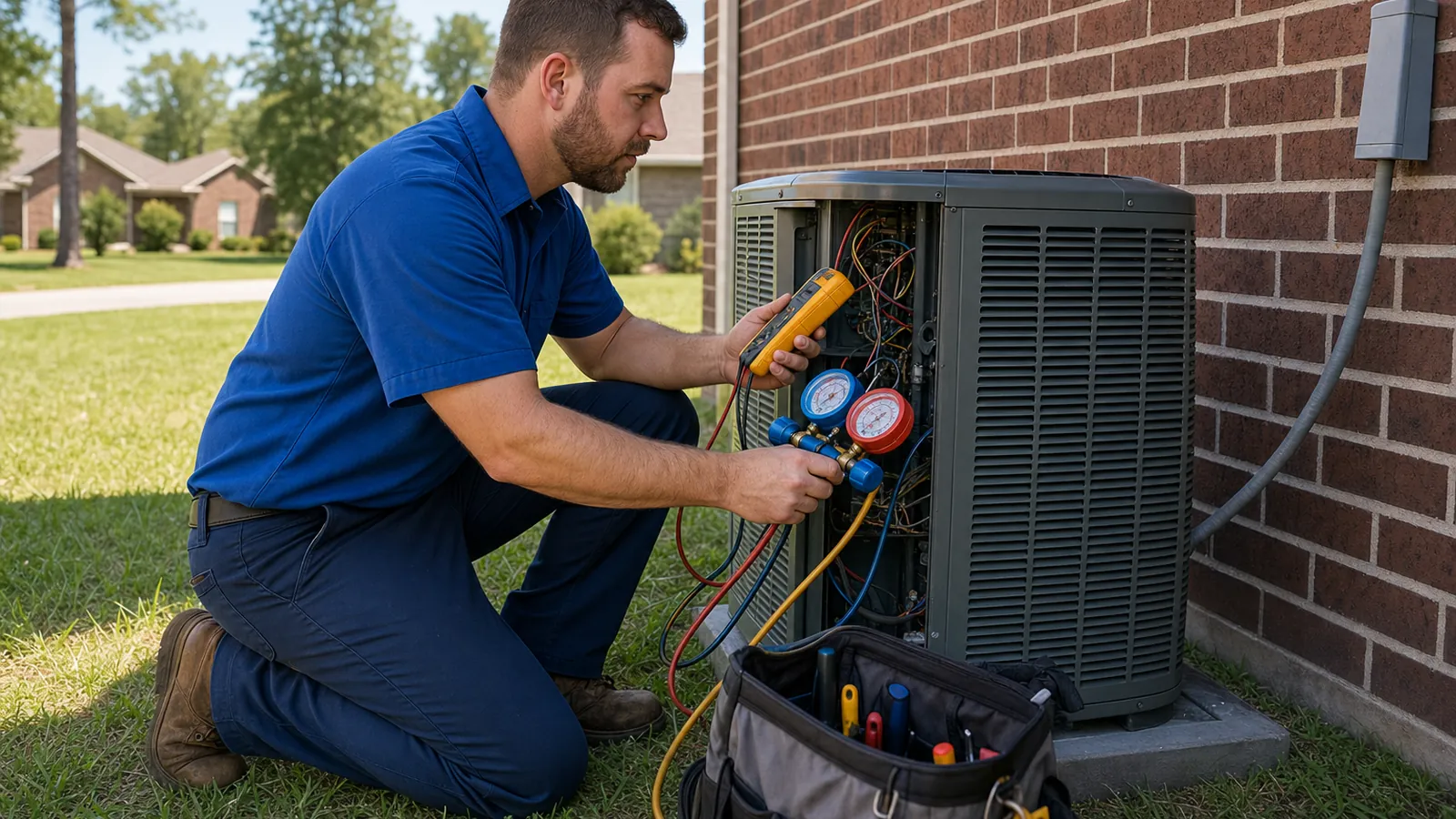
Early July in West Monroe means the air conditioner runs from morning until well after dark. So when the AC breaker keeps tripping, the house warms up fast, and it is tempting to flip it back on and hope. A breaker that trips is doing its job. It cuts power because the cooling circuit drew more current than the wiring can safely carry.
Here is what causes that on an air conditioner, what you can check without opening anything, and when the problem needs a technician.
What a Tripping Breaker Is Protecting You From
A circuit breaker has two ways to trip. A thermal element, usually a bimetal strip, bends as it heats and releases the switch when current stays too high for too long. A magnetic element reacts instantly to a very large surge, such as a short circuit or a ground fault.
That split matters, because the timing of the trip hints at the cause. A breaker that snaps off the moment power returns points toward a short or a grounded part. A breaker that holds for a while and then trips points toward a sustained overload.
When a breaker keeps tripping and someone keeps resetting it, each attempt pushes high current through the wiring, the contactor and the compressor windings again. Heat builds at every loose or weak connection. That is how insulation gets scorched, and how a starting problem can turn into a failed compressor. The NFPA's home electrical safety guidance lists frequently tripping breakers as a reason to call a qualified electrician.
What Makes an AC Circuit Draw Too Much Current
When an AC breaker keeps tripping, the cause is usually a motor working harder than it should, or a connection that is heating up.
- Weak capacitor: the run capacitor helps the compressor and outdoor fan motor start and run. Some systems add a start capacitor or hard-start kit. When a capacitor weakens, the compressor struggles to start and draws its high starting current for too long.
- Worn or grounded compressor: a worn compressor can draw more current while it runs. If a winding shorts to the compressor shell, the breaker usually trips at once.
- Failing condenser fan motor: the outdoor fan pulls air across the condenser coil. If it slows or stops, heat cannot leave the refrigerant, pressure climbs and compressor current rises with it.
- Dirty condenser coil: grass clippings, pollen and dirt on the outdoor coil do the same thing more slowly. Head pressure rises, and the compressor pulls more current in afternoon heat.
- Loose or corroded wiring: a loose connection at the contactor, the outdoor disconnect or the breaker creates heat that can trip it even at normal load.
- Worn breaker: breakers age too. After years of heat cycles, one can trip below its rating.
- Refrigerant problems: an overcharge or a restriction in the system can raise pressure and current.
Indoor Air Handler Breaker or Outdoor Condenser Breaker?
Most central systems have two breakers in the panel. The outdoor condenser, which holds the compressor and fan, usually sits on a double-pole 240-volt breaker. The indoor air handler or furnace, which runs the blower, has its own breaker. There is often a separate disconnect box on the wall next to the outdoor unit.
Knowing which one tripped narrows things quickly. If the outdoor breaker keeps tripping, the compressor, capacitor, fan motor, coil or outdoor wiring are the likely suspects. If the indoor breaker keeps tripping, suspicion shifts to the blower motor, its capacitor, the control board or indoor wiring.
One point confuses many people. A clogged condensate line that lifts a float switch shuts the system off, but it does not trip a breaker. The float switch opens the low-voltage control circuit, and the breaker stays on.
A West Monroe Scenario You Might Recognize
Picture a family whose AC runs fine through the morning. By late afternoon, when the house is working hardest to stay cool, the outdoor unit shuts off and the AC breaker keeps tripping. After a reset, it runs for a while, then trips again the next afternoon. Someone notices the outdoor fan spins slower than it used to. The coil fins behind the grille look matted with dust and grass clippings.
That pattern points to heat that cannot leave the outdoor unit. A dirty coil and a weak fan motor or fan capacitor both raise head pressure, and compressor current climbs with the afternoon temperature. Mornings go fine because the load is lighter then. A technician would measure the fan and compressor current, test the capacitor and inspect the coil before replacing anything.
What You Can Check Safely
These checks need no tools and keep your hands away from live parts.
- Note the timing: does the breaker trip the instant it is reset, a few seconds after the outdoor unit tries to start, or after a long run?
- Identify the breaker: read the panel label to see whether it is the outdoor condenser or the indoor air handler circuit.
- Listen at startup: a loud hum or buzz from the outdoor unit with the fan not turning suggests a starting problem. Turn the system off at the thermostat if you hear it.
- Look at the outdoor unit: clear grass, weeds and stored items away from all sides, and look for matted debris on the coil fins.
- Check the air filter: a clogged filter rarely trips a breaker by itself, but it strains the system and is quick to rule out. The ENERGY STAR maintenance checklist recommends checking filters once a month.
Safety Notes
- Reset once: turn the thermostat off, push the breaker fully to OFF, then back to ON. Wait a few minutes before calling for cooling.
- Leave it off after a second trip: a repeat trip means the fault is still there.
- Never install a larger breaker: the breaker size matches the wire and the maximum breaker size on the unit's nameplate. A bigger breaker lets the wires overheat.
- Never tape or hold it on: do not tape, wedge or hold a breaker in the ON position.
- Keep covers closed: do not open the panel cover, the outdoor disconnect or the unit's service panel. Capacitors can hold a charge after the power is off.
- Burning smell or scorch marks: turn the system off at the thermostat. If there is smoke, get everyone outside and call 911 from outside.
When to Call a Professional
Call when the AC breaker keeps tripping after one reset, when it trips instantly, or when you notice a burning smell, buzzing at the panel or scorch marks. Call as well if the outdoor unit hums without starting or the fan blade does not spin. If the system quits in the middle of a July heat wave, our emergency AC service is the right first call.
A technician will measure voltage and current, test the capacitor, check the contactor and wiring, and test the compressor windings for a ground. If the refrigerant charge is in question, EPA Section 608 rules require a certified technician for that work. The AC repair team at Mark Johnson & Sons Plumbing handles this kind of diagnosis on the equipment side.
Frequently Asked Questions
Why does the breaker trip only in the afternoon?
Afternoon is when outdoor heat, head pressure and run time all peak. A dirty condenser coil, a weak fan motor or a failing capacitor can hold up in the cooler morning and fail under that peak load.
Can a bad capacitor trip the breaker?
Yes. A weak capacitor can leave the compressor struggling to start, and the high starting current can last long enough to trip the breaker. Do not handle one yourself, since it can store a charge.
Is it safe to keep resetting the breaker?
No. One reset is reasonable. Repeated resets send high current through the same weak point each time, which heats wiring and connections and can damage the compressor.
Can regular maintenance prevent this?
It can catch many of the causes early. The ENERGY STAR checklist includes tightening electrical connections and measuring voltage and current on motors. An AC maintenance visit is a natural time for those checks.
Before You Call: What to Note
When the AC breaker keeps tripping, a few notes help the technician start in the right place. Write down which breaker tripped, indoor or outdoor. Note whether it trips instantly, at startup or after a long run, roughly what time of day, and whether the outdoor fan was spinning. Mention any humming, buzzing, burning smell or scorch marks, and when the system was last serviced. A phone photo of the panel label and the outdoor unit's nameplate also helps.
Then reach Mark Johnson & Sons Plumbing through our contact page, or book a time online for your West Monroe home. If the breaker tripped a second time, leave it off until a technician has looked at the system.