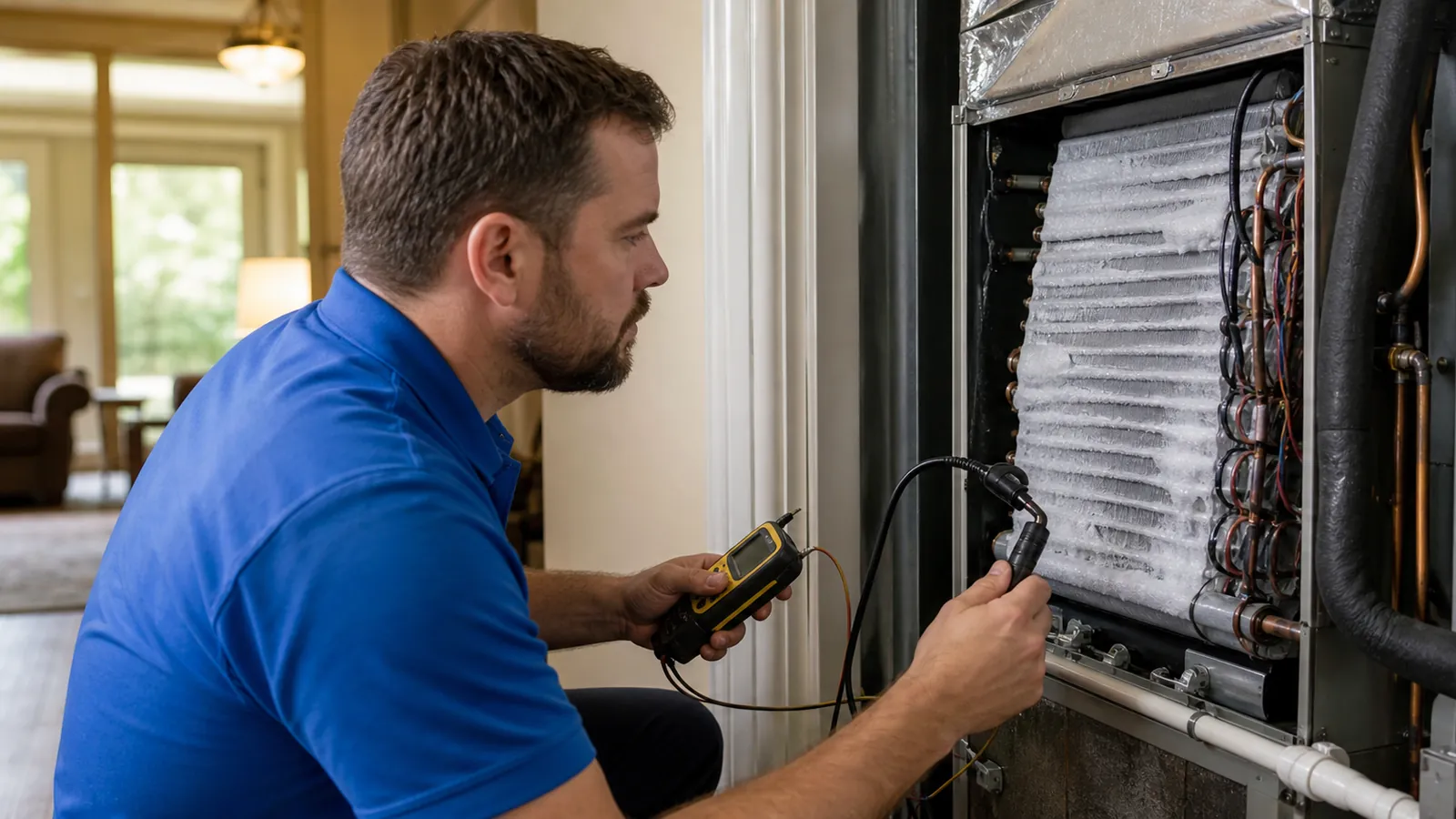
Finding your AC freezing up in Ruston during a July heat wave feels backward. The house is warm, the vents push weak air, and there is ice on a copper line outside. The ice is a symptom: something has pushed the indoor coil colder than it was built to run. This guide explains how that happens, how to thaw the system without damaging it, and what a technician checks so the ice does not come right back.
How Ice Forms on an Evaporator Coil in July
Your air conditioner cools the house with the evaporator coil, a bundle of copper tubes and thin aluminum fins inside the indoor unit. Refrigerant inside the coil evaporates and absorbs heat from the air the blower pushes across it. By design, the coil surface runs only a little above the freezing point of water.
That narrow margin matters in a humid North Louisiana summer, when the coil pulls a lot of moisture out of the air. That water normally drips into the drain pan and leaves through the condensate line. When the coil surface drops below 32°F, the water freezes in place instead of draining.
Ice then feeds on itself. A thin layer blocks some airflow, so less warm air reaches the coil, and the coil gets even colder. Frost thickens until it chokes the coil, then creeps along the suction line, the larger insulated copper line that runs to the outdoor unit. Our evaporator coil service page explains how this part works.
Common Causes of an AC Freezing Up
Almost every case of an AC freezing up comes down to two things: too little air moving across the coil, or too little refrigerant inside it.
- Dirty filter: a clogged filter starves the coil of warm air. The ENERGY STAR maintenance checklist says to check filters once a month, and our filter replacement guide covers the basics.
- Closed or blocked vents and returns: shutting several supply registers, or parking furniture over a return grille, cuts the total airflow.
- Failing blower motor: a weak motor, a bad capacitor or a dirty blower wheel moves less air than the system needs.
- Dirty evaporator coil: dust and pet hair mat onto the coil face and act like a second filter.
- Low refrigerant from a leak: refrigerant is not used up like fuel, so a low charge means some of it has leaked out. Lower pressure in the coil means a colder coil.
A Ruston Scenario You Might Recognize
Picture a family whose air conditioner has run nonstop through a hot Ruston week. By late afternoon, the thermostat sits several degrees above the setting. The air from the vents feels cool but weak. Someone notices frost on the insulated copper line at the outdoor unit, and a small puddle has formed near the indoor unit in the hall closet.
That pattern points to a coil that is freezing up. Weak airflow at the vents means ice is already blocking the coil. Frost at the outdoor unit means the cold has spread down the suction line. The puddle suggests that melting ice is overwhelming the drain pan. The open question is whether the cause is airflow or a refrigerant leak.
How to Thaw a Frozen AC Safely
The first job is to stop making more ice, and the steps are simple.
- Turn cooling off: set the thermostat to OFF so the compressor stops running.
- Run the fan if it works: switching the fan to ON moves warm indoor air across the coil and can speed thawing. Skip this step if the blower sounds wrong or does not run.
- Wait it out: a coil packed with ice can take several hours to thaw, sometimes longer.
- Watch the drain pan: melting ice releases a lot of water at once, so keep towels handy and check that the pan and condensate line are draining.
- Leave the ice alone: never chip or scrape it, because the thin fins and tubing puncture easily.
Restarting too soon usually ends with the system freezing up again. Melting the ice does not fix the dirty filter, weak blower or leak behind it, so the coil can drop below freezing again the same day. Running a frozen system can also send liquid refrigerant back toward the compressor, which is built to pump vapor.
What You Can Check Yourself
Once the coil has thawed, a few safe checks can point toward the cause before anyone opens the equipment.
- Filter: hold it up to a light, and if you cannot see light through it, replace it with the correct size.
- Vents and returns: open every supply register and clear anything blocking the return grilles.
- Airflow at the vents: after restarting, notice whether the air feels strong or weak compared with normal.
- Where the ice returns: note whether frost comes back on the indoor coil, the suction line or both, and how quickly.
- Drain line: make sure water is leaving through the condensate line and not pooling in the pan.
If the system runs normally with a new filter and open vents, keep an eye on it for a few days. Freezing up again after a filter change points toward the blower, the coil or the refrigerant charge, and that work belongs with a technician.
Safety Notes
- Turn the system off at the thermostat before inspecting anything, and keep the electrical panels on the indoor and outdoor units closed.
- Do not chip ice or aim a heat gun or hair dryer at the coil, since sharp tools and heat can damage fins, tubing and wiring.
- If you smell burning, see smoke or hear buzzing from the equipment, shut it off at the breaker if you can reach it safely. If smoke or a burning smell continues, leave the home and call 911 from outside.
- Wipe up meltwater promptly, since water near electrical equipment and on hard floors creates shock and slip hazards.
- Do not add refrigerant yourself or use a recharge kit. EPA rules restrict refrigerant sales for home air conditioning systems to certified technicians.
- While the system is down in summer heat, keep children, older adults and pets somewhere cool, since heat stress can become a health concern.
When to Call a Professional
Call a technician if the AC keeps freezing up after a filter change, if the blower will not run, or if water keeps overflowing the drain pan. Oily spots on refrigerant lines or fittings can also mark a leak.
A technician typically checks:
- Airflow: blower speed, motor and capacitor condition, and whether the blower wheel is clean.
- Static pressure: a manometer reading shows whether the filter, coil or ducts are restricting air.
- Coil condition: dirt on the coil face and damage to the fins.
- Refrigerant charge: gauge and temperature readings compared with the manufacturer's specifications.
- Leak search: if the charge is low, finding and repairing the leak before any recharge.
Refrigerant work requires EPA Section 608 technician certification. Our refrigerant service page and AC repair page explain what those visits cover.
Frequently Asked Questions
Why is my AC freezing up when it is so hot outside?
Heat outside does not protect the indoor coil. The coil runs just above freezing on purpose, and in humid weather it carries a heavy load of moisture. Low airflow or low refrigerant tips it below 32°F, and that moisture turns to ice.
How long does a frozen AC take to thaw?
Light frost may clear in an hour or so. A coil packed with ice can take several hours, sometimes longer. Running the fan with cooling turned off usually speeds it up.
Can I keep running my AC while it is frozen?
It is not a good idea, because a frozen coil barely cools the house, the ice keeps growing, and liquid refrigerant can reach the compressor.
Will adding refrigerant fix a frozen AC?
Only when low charge is the cause, and only after the leak is found and repaired. Adding refrigerant without a leak repair just lets it escape again.
Get Your Frozen AC Checked in Ruston
If you have thawed the system and it is freezing up again, the coil is telling you something is still wrong. Before you reach out, jot down a few details. Note when you first saw ice, whether it formed indoors, outdoors or both, when the filter was last changed, and whether the airflow feels weak.
Then contact Mark Johnson & Sons Plumbing through our contact page or book a time online. Those notes help a technician start with the right checks. Mark Johnson & Sons Plumbing handles heating and cooling in Ruston, Monroe and across North Louisiana. A frozen coil in July is worth handling early, since running the system while iced can strain the compressor.