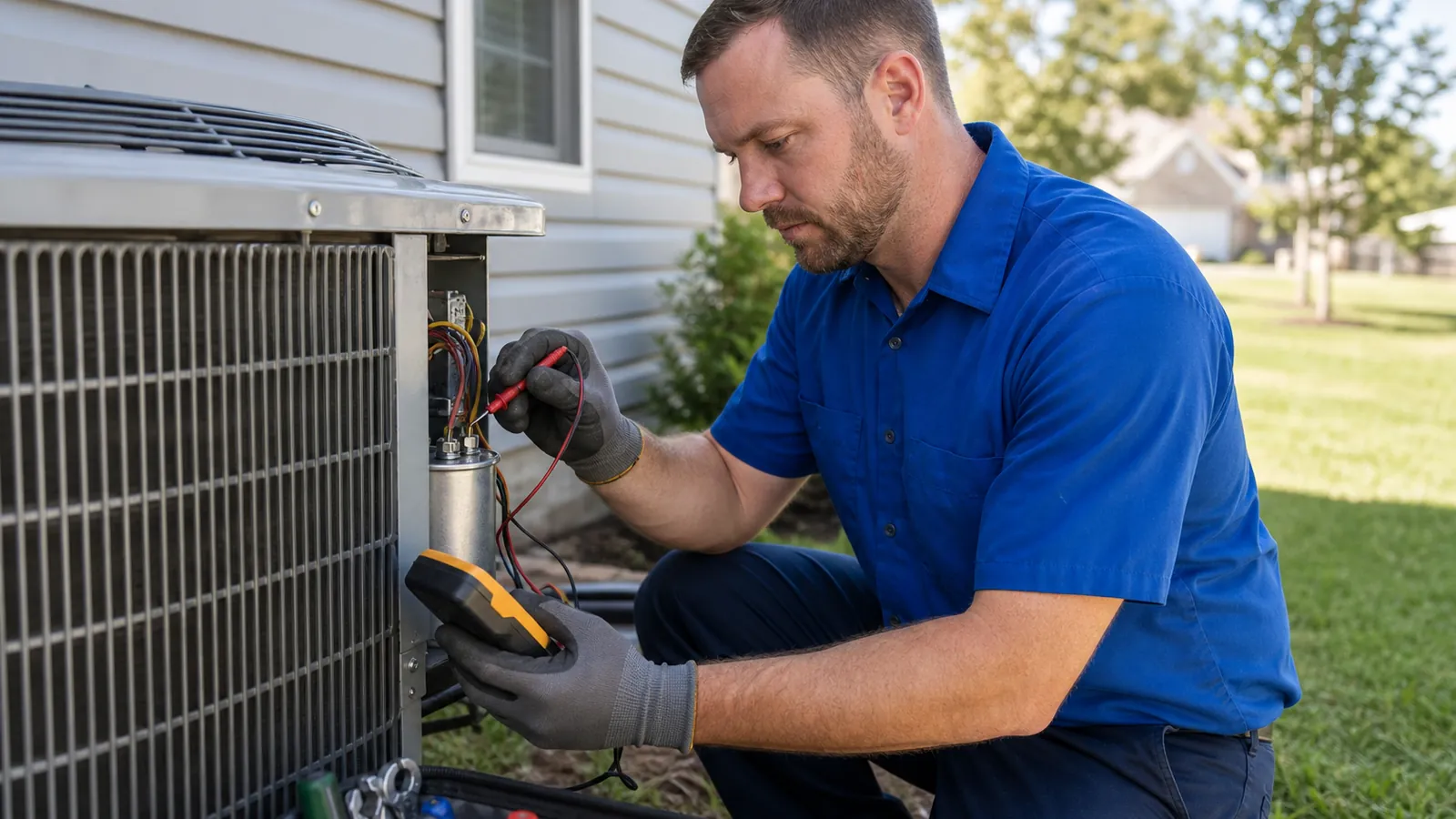
It is a July afternoon in Monroe, the thermostat keeps climbing, and the system has run for hours. When your AC is not cooling but the equipment still runs, the cause usually fits one of three groups. The system is moving too little air, it cannot release heat outdoors, or a part has quietly failed. Here is what happens inside the equipment, which checks are safe, and when to bring in a professional.
How an Air Conditioner Moves Heat Out of Your Home
An air conditioner does not make cold air. It moves heat from inside the house to the outside, using refrigerant in a sealed loop.
Indoors, a blower pulls warm air through the return grille and filter, then pushes it across the evaporator coil. Cold refrigerant in that coil absorbs heat and pulls moisture from the air.
Outdoors, the compressor pumps the heat-loaded refrigerant into the condenser coil. The condenser fan pulls outdoor air through the coil fins and carries the heat away.
If air cannot reach the indoor coil, or heat cannot leave the outdoor coil, the blower keeps running while the house stays warm. That is how a system ends up not cooling even though you can hear it working.
Airflow and Coil Problems That Block Cooling
Many cases of an AC not cooling start with air that cannot move freely across one of the two coils.
- Dirty air filter: a clogged filter starves the evaporator coil of air. The coil can drop below freezing and ice over, which blocks airflow even more. The ENERGY STAR maintenance checklist recommends inspecting filters once a month.
- Blocked return grilles: furniture pushed against a return starves the system the same way.
- Dirty condenser coil: the outdoor coil collects cottonwood fluff and pollen in spring, then grass clippings all summer. A matted coil cannot shed heat, so pressures climb and capacity drops.
- Dirty evaporator coil: dust that slips past a loose filter coats the indoor coil like a blanket.
If you would rather not track filter sizes and swap dates, Mark Johnson & Sons Plumbing also handles air filter replacement.
Failed Parts, Refrigerant Leaks and Leaky Ducts
When airflow checks out, a system that is not cooling usually has a failed part or a leak.
- Failed run capacitor: the capacitor gives the compressor and condenser fan motor the boost they need to start and keep running. A weak one often leaves the outdoor unit humming while the fan sits still.
- Failed condenser fan motor: if the fan will not spin, heat builds up outdoors. The compressor may shut off on its internal overload, then restart and trip again.
- Refrigerant leak: refrigerant is not used up like fuel. It circulates in a sealed system, so a low charge means a leak. Adding refrigerant without fixing the leak only delays the next breakdown, so leak repair comes first with refrigerant service.
- Leaky attic ducts: many local homes run ductwork through a hot attic. According to ENERGY STAR guidance on duct sealing, about 20 to 30 percent of the air moving through a typical duct system is lost to leaks, holes and poor connections. Supply leaks dump cooled air into the attic, and return leaks pull attic heat back in.
When Extreme Heat Is the Real Limit
Not every warm afternoon means the system is broken. A home cooling system is sized to hold a comfortable indoor temperature up to a set outdoor temperature, called the outdoor design temperature. On the hottest, most humid July days in North Louisiana, the weather can push past that point.
A healthy system may then run nonstop all afternoon and still lose a little ground. The sign of a capacity limit, rather than a failure, is recovery in the evening as the heat eases.
If the indoor temperature keeps rising overnight, a part has likely failed, so call for service instead of waiting for a cooler day. If older adults, infants or anyone with a medical condition live in the home, treat a failed system in July as urgent. The National Weather Service heat safety page explains how to stay safe until the repair is done.
What You Can Check Safely at Home
These checks take minutes and need no tools.
- Thermostat mode: confirm it is set to COOL and the setpoint is below room temperature.
- Fan setting: set the fan to AUTO instead of ON. On ON, the blower keeps moving air while the compressor rests, and that air can feel warm and muggy.
- Air filter: if you cannot see light through it, replace it.
- Breakers and disconnect: make sure the indoor and outdoor breakers are on, and that an outdoor disconnect with an outside handle is set to ON. Reset a tripped breaker one time only.
- Outdoor unit: from a few feet away, see whether the fan spins or the unit only hums.
- Clearance: clear leaves, grass and weeds from around the outdoor unit.
- Temperature split: after a long run, hold a kitchen thermometer at a supply register, then at the return grille. Many technicians use a rough rule of thumb of about 15 to 20 degrees Fahrenheit of drop, though humidity and system design shift that range. A much smaller split points to a real problem.
A Monroe Scenario You Might Recognize
Picture a family in Monroe whose AC is not cooling on a hot July afternoon. The thermostat reads several degrees above the setting and keeps creeping up. The vents are blowing, but the air feels only slightly cool. Outside, the unit hums steadily, yet the fan on top is barely turning. Every so often the humming stops, then starts again minutes later.
That pattern points to the outdoor side. A fan that will not spin while the unit hums often means a weak run capacitor or a failing condenser fan motor. The stop-and-start cycle suggests the compressor is overheating and shutting off on its internal protection. Running it that way adds strain, so the family's best move is to turn it off at the thermostat and book an AC repair visit.
Safety Notes
- Electrical parts: do not open the outdoor unit's service panel or the disconnect box. Capacitors can hold a dangerous charge even after the power is turned off.
- Refrigerant: leave refrigerant work to a certified HVAC professional. EPA rules under Section 608 of the Clean Air Act require technicians who service refrigerant equipment to be certified.
- Frozen coil: if you see ice on the copper lines or indoor coil, set the thermostat to OFF and the fan to ON so it can thaw. Running the compressor against ice can damage it.
- Burning smell or smoke: turn the system off, get everyone outside, and call 911 from outside the home.
- Gas smell: if you smell gas near the furnace or air handler, leave the house and call your gas utility's emergency line or 911 once you are outside.
When to Call a Professional
Call for service when the simple checks do not bring back an AC that is not cooling. Specific signs include:
- The outdoor fan does not spin, or the unit hums without starting.
- A breaker trips again after one reset.
- You see ice on the refrigerant lines or the indoor coil.
- The temperature split stays small even with a clean filter.
- You hear hissing or bubbling near the coils, which can point to a refrigerant leak.
A technician can test the capacitor with a meter, check refrigerant pressures, trace leaks and measure airflow. Regular AC maintenance catches many of these problems earlier, before the hottest weeks arrive.
Frequently Asked Questions
Why is my AC running but not cooling the house?
The usual causes are a dirty filter, a dirty outdoor condenser coil, a failed capacitor or fan motor, or low refrigerant from a leak.
Can I just add refrigerant to fix it?
No. Refrigerant circulates in a sealed loop and does not get used up. A low charge means there is a leak, so the repair belongs with a certified HVAC professional.
Should the fan be set to ON or AUTO in summer?
AUTO usually works better in humid weather. The blower stops with the compressor, so moisture on the coil can drain away instead of blowing back into the house.
Your Next Step
Before you reach out, jot down a few details. Note what the thermostat reads compared with its setting, whether the outdoor fan spins, and when the filter was last changed. Write down any ice, hissing, humming or burning smell, and which rooms feel warmest. Those notes help a technician narrow down the cause faster.
Mark Johnson & Sons Plumbing handles cooling repair for homes in Monroe, West Monroe and nearby North Louisiana towns. If your AC is not cooling, share those details through our contact page or pick a time with online booking. An early check can keep a small problem, like a weak capacitor, from turning into a compressor failure.